
When a parent needs help around the clock but doesn't want to leave home, live-in care often comes up as the answer. It sounds simple: one caregiver, living in the home, always there. In practice, the costs and logistics behind that arrangement vary a great deal depending on whether you hire through an agency or try to sponsor a caregiver yourself. Understanding both paths before you commit can save a family real money, and real heartache.
What "Live-In Care" Actually Means
Live-in care means a caregiver resides in the home and provides support during the day, with a defined overnight sleep period, rather than working in back-to-back shifts. It's different from 24-hour shift care, where two or more caregivers rotate so someone is always awake and actively working. If your parent needs frequent overnight assistance (repositioning, toileting, wandering supervision), shift care may be the safer choice. Our detailed comparison of live-in care versus 24-hour shift care walks through how to tell which one fits your situation.
Agency Live-In Care: What It Costs
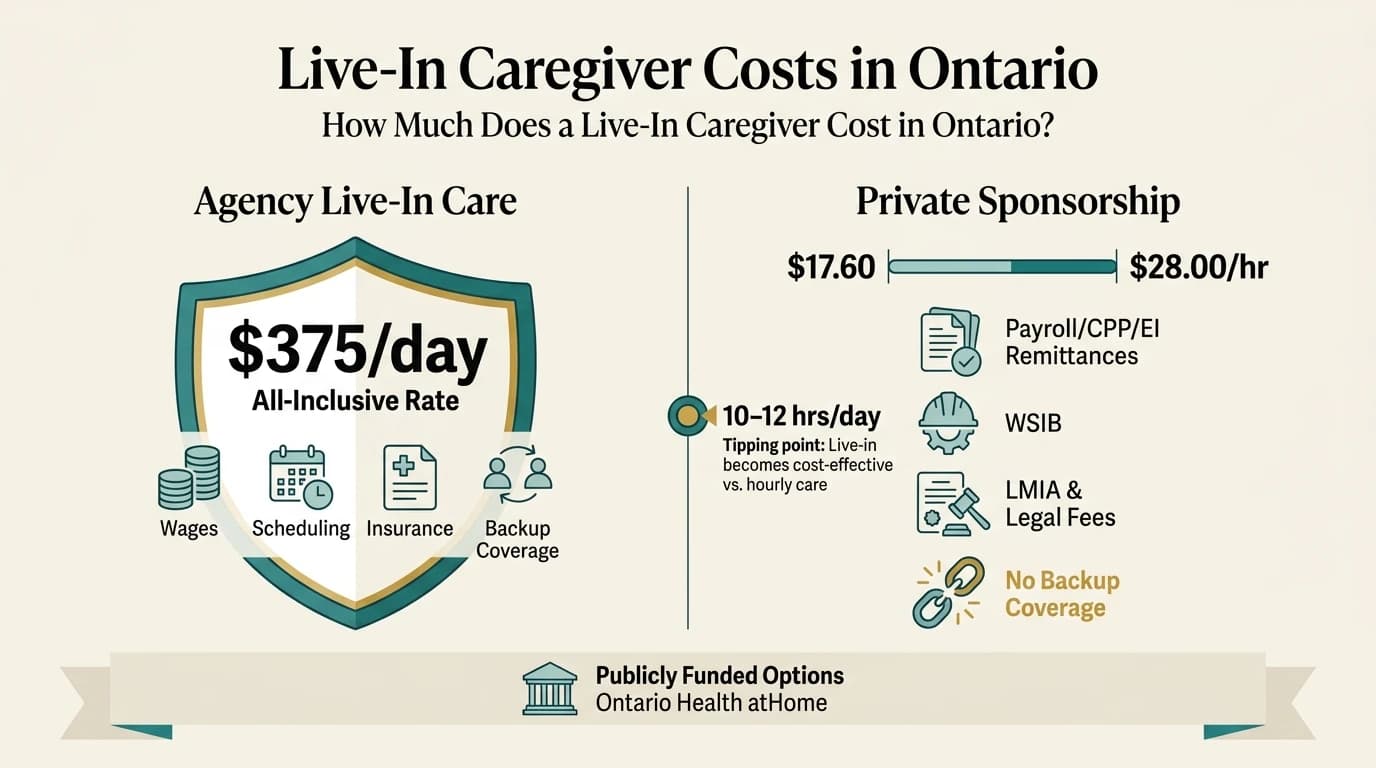
When you arrange live-in care through a home care agency, you pay a single daily rate that covers the caregiver's wages, scheduling, supervision, insurance, backup coverage, and payroll administration. At Living Assistance Services, live-in care is currently billed at $375 per day. That single figure is meant to make budgeting straightforward: no separate payroll, no remittances, no scrambling to find someone if your caregiver is sick or wants a vacation.
In practice, families comparing agency live-in care to hourly personal support often find that once a parent needs more than roughly 10 to 12 hours of support a day, the live-in daily rate becomes more cost-effective than paying hourly for the same coverage. A care coordinator can run these numbers against your parent's actual care needs during a free in-home assessment.
Sponsoring a Live-In Caregiver Yourself: Costs and Risks
Some families consider hiring a caregiver directly and sponsoring them to work and live in Canada, rather than going through an agency. This route can look less expensive on paper, but it comes with costs and risks that are easy to underestimate.
Wages. Live-in caregivers for seniors in Ontario typically earn between $17.60 and $28.00 per hour, according to Government of Canada wage data from Job Bank. For a live-in arrangement, that can add up to a full-time wage plus overtime rules under Ontario employment standards, since the caregiver is your employee, not a contractor.
Employer obligations. As the employer of record, you are responsible for CPP and EI remittances, WSIB coverage, vacation pay, and proper payroll records. Getting this wrong can expose your family to fines or back-pay claims.
Immigration and recruitment costs. Sponsoring a foreign worker typically involves a Labour Market Impact Assessment (LMIA) application fee, recruitment or agency finder's fees, and often legal or immigration consultant fees. Processing can take months, during which your parent still needs care.
Coverage gaps. If your privately sponsored caregiver is sick, injured, wants time off, or simply leaves the job, you have no backup. Families in this position often call an agency for emergency respite while they search for a replacement, which can mean paying twice for the same period.
Liability. If the caregiver is injured in your home, or if a dispute arises over hours, duties, or termination, you carry that risk personally as the employer, not a company with HR and insurance infrastructure behind it.
Our broader look at the pros and cons of a home care agency versus a private caregiver covers these trade-offs in more depth if you're still weighing the decision.
Publicly Funded Options Worth Checking First
Home care isn't covered under the Canada Health Act the way hospital or physician services are, so it isn't part of universal health coverage in Canada. Instead, provincial programs subsidize a limited, needs-tested number of home care hours (PMC, 2023). If your parent qualifies, the Ontario government will fund some home care; if the funded hours aren't enough, or your parent doesn't qualify, private care fills the gap (Ontario.ca).
Ontario Health atHome also offers self-directed funding for eligible individuals, letting families choose and pay a provider of their choice directly rather than being assigned one (Ontario.ca). It's worth applying and understanding what, if anything, you qualify for before budgeting entirely out of pocket. Our guide to free and low-cost home care options in Ontario explains how to start that process.
Making the Decision
There's no universally right answer between agency live-in care and privately sponsoring a caregiver. A family with the time, HR knowledge, and appetite for risk may save money sponsoring directly over a long period. Most families we work with prefer the predictability of a flat daily rate, a vetted and insured caregiver, and a team that steps in immediately when something changes. A free in-home assessment is a good next step either way: it gives you an honest, specific picture of how many hours or what kind of coverage your parent actually needs, which is the number every cost comparison should start from.
Frequently Asked Questions
Is live-in care cheaper than 24-hour shift care?
Usually, yes. Live-in care uses one caregiver with a scheduled overnight rest period, while 24-hour shift care requires two or more caregivers rotating so someone is always awake. If your parent needs frequent overnight help, though, shift care may be safer despite the higher cost.
Can I get government funding to help pay for live-in care?
You may qualify for subsidized home care hours through Ontario's needs-tested program, or for self-directed funding through Ontario Health atHome that lets you choose your own provider. Coverage varies by individual circumstances, so it's worth applying to find out what you qualify for before assuming you'll pay entirely out of pocket.
What's included in the $375-a-day live-in care rate?
The daily rate covers the caregiver's wages, scheduling and supervision, insurance, and backup coverage if your regular caregiver is unavailable. You don't handle payroll, remittances, or finding a replacement yourself.
Is it legal to sponsor a caregiver to live and work in my home?
Yes, but it involves specific immigration pathways, employer obligations under Ontario employment law, and often a Labour Market Impact Assessment. Speak with an immigration consultant or employment lawyer before proceeding, since the requirements and fees change periodically.
How do I know if my parent needs live-in care versus part-time help?
The clearest way is a professional assessment of your parent's daily needs, mobility, and safety risks at home. A free in-home assessment gives you a specific recommendation rather than a guess, and you can also read our guide on how much assistance an aging parent needs for a starting framework.