
When a parent's needs go beyond a few hours of help a day, families often start searching for "24 hour PSW" care. The phrase gets used loosely, and it can mean different things depending on who you ask. Understanding what round-the-clock personal support worker (PSW) care actually involves, and how it differs from live-in arrangements, makes it much easier to plan and budget with confidence.
What "24-Hour PSW" Actually Means
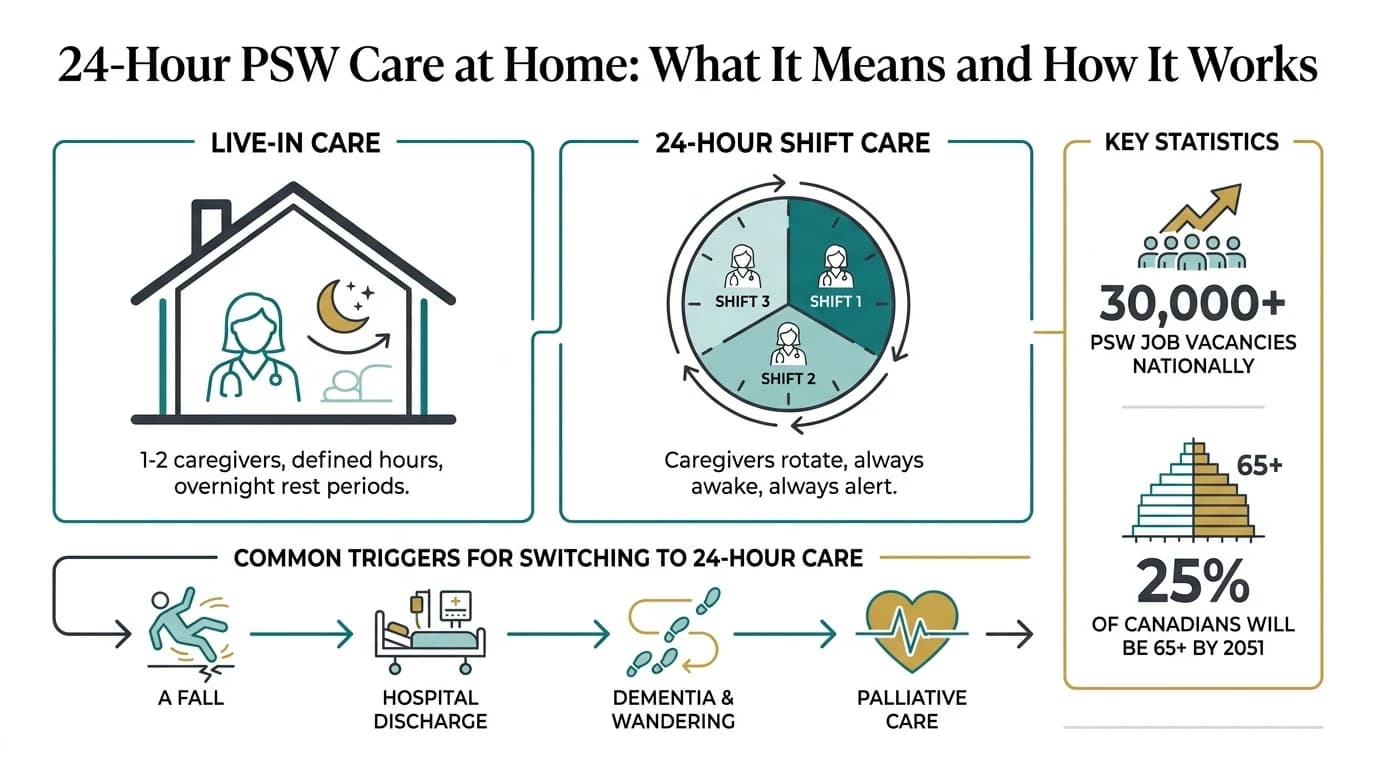
24-hour PSW care means a personal support worker is present and awake in the home at all times, providing help with bathing, dressing, toileting, mobility, medication reminders and safety supervision around the clock. This is different from a single caregiver who sleeps over. In a true 24-hour model, care is delivered in shifts, so the worker on duty is always alert and able to respond immediately, whether that's helping someone to the bathroom at 3 a.m. or managing a fall risk overnight.
This level of support is typically arranged through a home care provider rather than through Ontario's publicly funded system, which is generally built around scheduled visits rather than continuous, one-to-one presence. In Ontario, Assisted Living Services exist for people who need more support than scheduled Ontario Health atHome visits provide, but they stop short of the 24/7 nursing supervision found in a long-term care home. For families who want continuous, dedicated support at home, private-pay 24-hour PSW care fills that gap.
24-Hour Care vs. Live-In Care: What's the Difference
This is the question we hear most often, and it matters for both safety and budget.
- Live-in care: one or two caregivers reside in the home, typically working defined daytime hours and being available overnight for occasional needs, with built-in rest periods. It suits clients who are relatively stable overnight and mainly need supervision plus quick response if something comes up.
- 24-hour (shift) care: caregivers rotate in shifts, commonly two 12-hour shifts or three 8-hour shifts a day, so someone is always awake and actively providing care, never sleeping on the job. It suits clients with higher overnight needs: frequent repositioning, incontinence care, wandering related to dementia, or a medical condition that requires close monitoring.
Families exploring either option can review live-in care and personal care to see how each is structured before deciding which fits their situation.
When Families Consider 24-Hour PSW Support
In practice, families usually move to 24-hour care after a specific trigger rather than as a first step. Common reasons include:
- A fall or hospital discharge where the person can no longer be safely left alone overnight.
- Progressing dementia with nighttime wandering, agitation, or reversed sleep patterns.
- A palliative diagnosis where comfort and symptom management need continuous attention.
- A family caregiver reaching burnout after months of overnight responsibility on top of daytime obligations.
As the population ages, this kind of need is only becoming more common: Statistics Canada projects a quarter of the population will be 65 or older by 2051, and roughly 30% of older Canadians already live with three or more chronic conditions, both of which increase the likelihood of needing intensive, round-the-clock support at some point (CIHI).
For clients managing ongoing medical needs alongside daily care, it's worth asking whether chronic disease care or nursing and RN-supervised care should be layered in alongside PSW shifts.
How Staffing Works in Practice
A reputable provider builds a small, consistent team, often two to four PSWs, who rotate through the same shifts so the client sees familiar faces rather than a revolving door of strangers. This matters for trust and for continuity, especially with clients living with dementia, where consistency reduces confusion and agitation.
It's also worth knowing that Canada is facing a real shortage of personal support workers. PSW vacancies were the single largest category of health care job openings nationally, at over 30,000 positions in 2022–2023 (CIHI), and the occupation is projected to face continued labour shortage pressure through 2033 (Job Bank). In practice, this means families should start the process of arranging 24-hour care with some lead time, rather than waiting for a crisis, and should ask any provider directly how they recruit, vet and schedule backup coverage when a regular caregiver is sick or on vacation.
What It Costs and How to Plan
24-hour shift care costs more than live-in care because it requires two or three paid shifts per day rather than one live-in arrangement, and rates vary by city, the complexity of care and whether nursing oversight is included. Rather than guessing, ask a provider for a written rate breakdown by shift length and by role (PSW versus RN-supervised visits), and ask whether rates differ for overnight versus daytime hours. A free in-home assessment is the right first step: a care coordinator can observe the client's actual needs, recommend the right mix of live-in versus shift care, and provide a clear cost estimate before anything is committed to.
How to Arrange 24-Hour PSW Care
Start with a conversation, not a contract. A good provider will assess mobility, cognition, medication needs and home safety, then propose a staffing plan, whether that's full 24-hour shift coverage, a live-in caregiver with occasional overnight backup, or a hybrid that shifts as needs change. Many families also request a free home-safety assessment at the same time, since fall risks and overnight wandering often shape the staffing plan as much as the medical picture does.
Frequently Asked Questions
Is 24-hour PSW care the same as live-in care?
No. Live-in care usually means one or two caregivers residing in the home with rest periods, while 24-hour care means caregivers rotate in shifts so someone is always awake and actively providing support. The right choice depends on how much overnight assistance the client actually needs.
How many caregivers are involved in 24-hour care?
Most providers rotate a small, consistent team of two to four PSWs through set shifts, rather than sending a different person each time. This supports continuity, which is especially important for clients living with dementia.
Can 24-hour PSW care include nursing tasks?
PSWs handle personal care, mobility support and medication reminders, but tasks like wound care, injections or complex medical monitoring require a registered nurse. Many families combine PSW shifts with RN-supervised nursing care for a complete plan; speak with a care coordinator or the client's doctor to confirm what's needed.
How quickly can 24-hour care be arranged after a hospital discharge?
Timelines vary by provider and by how urgent the situation is, but starting the conversation as early as possible, ideally before discharge, gives a team time to build the right schedule. Given ongoing PSW shortages across Canada, earlier planning also improves the odds of securing a consistent, familiar care team.
What does 24-hour PSW care cost compared to a retirement home or long-term care?
Costs depend on the city, the number of shifts and the complexity of care, so it's best to request a specific quote after an assessment rather than relying on general figures. A care coordinator can also help compare the cost and fit of home care against retirement home care or long-term care support if you're weighing multiple options.