
Choosing a home care company for a parent is one of those decisions that feels bigger than it looks on paper. You're not just hiring a service, you're inviting someone into your family's daily life. So when families search for "trusted home care companies in Ontario," they're really asking a more personal question: who will treat my mother the way I would want her treated?
There isn't a single official ranking of home care companies in Ontario. Trust has to be assessed the way you'd assess it for any important relationship: history, transparency, accountability and what happens when things go wrong. Here's how to do that well.
What "Trusted" Actually Means in Home Care
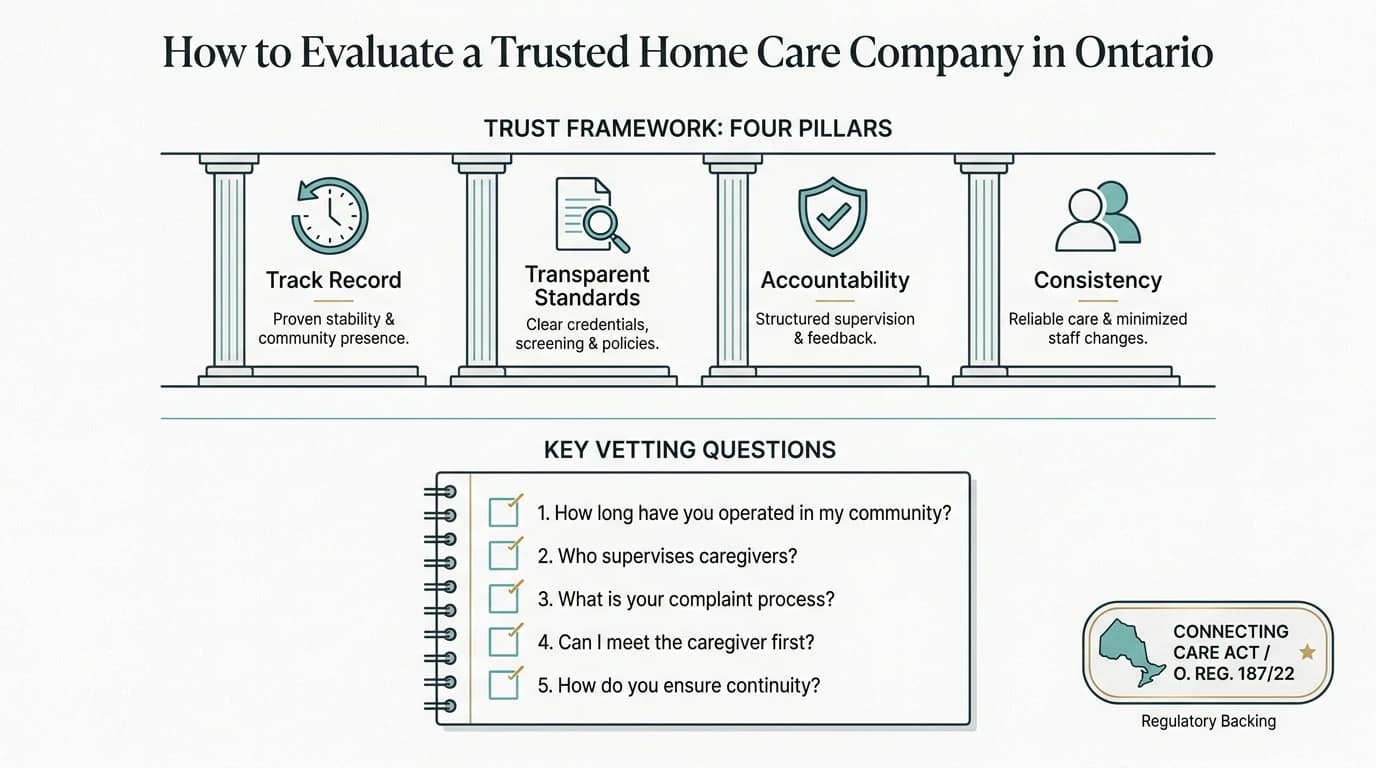
Trust in home care is built from a few concrete things, not marketing language:
- A track record. How long has the company been operating in your community, and under what name?
- Transparent standards. Can they explain, in plain terms, how caregivers are screened, trained and supervised?
- Accountability. Is there a clear process if you have a concern, and does someone actually respond?
- Consistency. Do families get the same caregiver relationship over time, rather than a rotating cast of strangers?
A company that has served the same neighbourhoods for many years, with long-tenured staff and repeat referrals from families and healthcare professionals, has earned a different kind of trust than one with a newer or thinner history.
Ontario's Regulatory Framework Backing Trust
Ontario's home care sector isn't unregulated. The province's home and community care system is coordinated through Ontario Health atHome, which manages publicly funded home care and, where a person qualifies, the government pays for that care; families can also choose to pay privately for care through private companies. If you're weighing public versus private-pay options, that's the starting distinction to understand.
Ontario Health atHome, with support from Ontario Health, also runs a service provider prequalification process, a key step in procuring safe, high-quality home care services across the province. That process follows the Ontario Public Service Procurement Directive, so it's built around openness, fairness and transparency, not just a company's own claims.
On top of that, Ontario's Connecting Care Act and O. Reg. 187/22 modernized the legal framework for home care. It names specific home care service categories, protects client rights, requires a formal complaints and appeals process, and is backed by enforcement, with standards now set by Ontario Health rather than 14 separate regional bodies as in the past. In practice, this means a home care company operating in Ontario today is working inside a more codified, accountable system than families may expect.
Your Rights as a Client Are Written Into Law
One detail families rarely hear about, but should: O. Reg. 187/22 includes a Home and Community Care Bill of Rights that applies to everyone receiving services under the Act. It guarantees the right to participate in your own assessment and care plan, and the right to give or refuse consent to any service offered. A trustworthy home care company will walk you through these rights as a matter of course, not bury them in fine print.
If a family believes a client was wrongly denied publicly funded care, or disagrees with a coordinator's decision, they can file a complaint with Ontario Health atHome and, if unresolved, appeal to the Health Services Appeal and Review Board (HSARB). Knowing this pathway exists is itself a form of protection, whether or not you ever need to use it.
History and Track Record Matter
When you're comparing companies, ask direct questions about history:
- How many years has the company operated under its current name in this specific region?
- Are staff employees (with supervision, insurance and training records) or independent contractors booked through an app?
- What professional oversight exists, for example RN-supervised nursing care, rather than just personal support?
- Can they name specific communities they've served for years, not just a general service area?
A company willing to answer these questions specifically, rather than vaguely, is generally one worth taking seriously.
What Quality Home Care Looks Like Day to Day
Satisfaction data backs up something families often sense intuitively: home care that actually works tends to be relationship-based, not transactional. According to CIHI, 9 out of 10 Canadian seniors surveyed who received publicly funded home care said it helped them remain at home, and 93% said they were satisfied with the service. Home care in Canada also spans a wide range of needs, from short-term recovery after surgery to long-term chronic disease support to specialized palliative and rehabilitation care, so "quality" looks different depending on what stage of care your family is in.
In practice, families often notice quality in small, unglamorous moments: a caregiver who remembers a parent takes tea, not coffee, or who calls ahead if they're running five minutes late. Consistency of caregiver matters more than families expect going in, and it's worth asking any provider directly how they schedule to protect that continuity.
Questions to Ask Any Home Care Company
Before signing with any provider, public or private:
- How long have you operated in my specific community?
- Who supervises caregivers, and how often?
- What is your process if I have a complaint?
- Can I meet the caregiver before care begins?
- How do you handle continuity if my regular caregiver is sick or on vacation?
Where Living Assistance Services Fits In
Living Assistance Services has provided personalized, relationship-centred home care across Toronto, the GTA and Southern Ontario, including North York, Markham, Richmond Hill, Mississauga, Oakville, Burlington, Hamilton, Durham Region and Ottawa, for many years. Care is delivered wherever a client lives: at home, in a retirement home, in long-term care, or in hospital. Services range from Personal Support Services, Dementia Care and Palliative Care to RN-supervised Registered Practical Nursing Care, Physiotherapy, Wound Care and Companionship, so a client's plan can evolve as their needs change without switching providers.
If you're evaluating home care companies for a parent, the most useful next step is often a direct conversation about your specific situation. You can Book a Free Assessment, which includes a free in-home assessment (a free home-safety assessment is also available) to talk through what care actually looks like for your family, with no obligation.
Frequently Asked Questions
Is private home care in Ontario regulated?
Yes. Private home care companies operate within Ontario's broader legal framework under the Connecting Care Act and O. Reg. 187/22, which sets service categories, client rights and complaint processes. Always ask a provider directly how they train, supervise and screen staff, since standards can still vary by company.
What's the difference between government-funded and private-pay home care in Ontario?
Government-funded home care is coordinated through Ontario Health atHome and available to those who qualify through an assessment; private-pay care is arranged directly with a company like Living Assistance Services, with no waitlist and more flexibility over hours, caregiver choice and services. Many families use both, filling gaps in publicly funded hours with private care.
How do I check a home care company's track record?
Ask how long they've operated under their current name in your specific city or region, request references, and ask directly about caregiver screening, training and supervision. A company with a long, stable local history and named service offerings is generally easier to evaluate than one with vague claims.
What should I do if I'm unhappy with a home care provider?
Raise the concern directly with the company first and ask about their complaints process. If the care is publicly funded through Ontario Health atHome, you can file a formal complaint and, if unresolved, appeal to the Health Services Appeal and Review Board.
Does home care replace the need for a doctor or care coordinator?
No. Home care supports daily living, recovery and chronic disease management, but medical decisions should still involve your family doctor, pharmacist or a care coordinator. A reputable home care provider will encourage this collaboration rather than work around it.