
Few conversations feel more awkward than asking a parent, "Who would make decisions for you if you couldn't?" But a power of attorney is one of the most practical documents a family can put in place. It doesn't just sit in a drawer waiting for a crisis. It quietly defines who can pay the bills, talk to the bank, or make a care decision the moment it's needed. If you're helping a parent set one up, or you've just been named as one yourself, here is what the role actually involves under Ontario law.
What a Power of Attorney Actually Is
A power of attorney is a legal document that gives someone you trust the right to make financial or health care decisions for you. That trusted person, called your attorney, does not have to be a lawyer. It can be a spouse, an adult child, a sibling, or a close friend. Ontario.ca
It's easy to confuse a power of attorney with a will, but they work in opposite directions. A will only takes effect after death and covers how property is distributed. A power of attorney only applies while the person is alive, and it stops the moment they die. Ontario.ca
The Two Types of Power of Attorney in Ontario
Ontario recognizes two distinct documents, and families often need both:
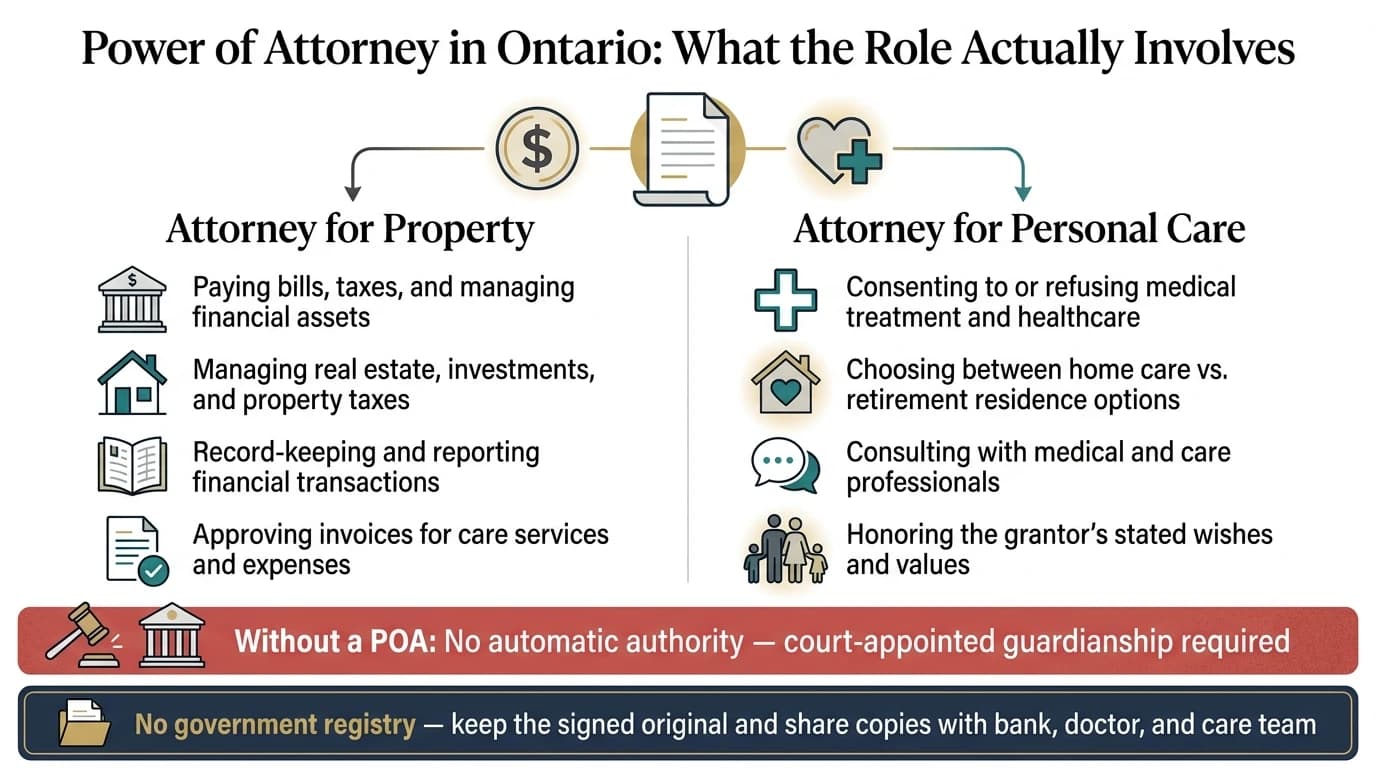
- Power of attorney for property. This covers financial and legal decisions: paying bills, managing investments, filing taxes, or handling the sale of a home.
- Power of attorney for personal care. This covers health care, housing, and day-to-day personal decisions, such as approving a move into a retirement residence or consenting to a treatment plan.
They can be given to the same person or split between two different people, depending on who has the time, the temperament, or the geographic proximity to take each on.
Duties of an Attorney for Property
Once named, an attorney for property can typically start managing finances immediately, unless the document says otherwise. Ontario.ca That authority is significant, and it comes with real legal obligations. An attorney for property must:
- Act in the grantor's best interest, not their own.
- Keep accurate, detailed records of all transactions.
- Manage finances and property according to any directions written into the document itself.
- Follow the legal duties set out for attorneys in the province where the grantor lives. Canada.ca
In practice, this often means an attorney ends up reviewing bank statements, approving invoices for care services, and making sure property tax and utility payments don't lapse. Families arranging in-home support frequently find that the attorney for property is the one who reviews and approves invoices for services like Personal Support Services or Registered Practical Nursing Care, so it helps if that person is organized and comfortable with paperwork.
There's no government registry for these documents. Ontario.ca That means it's up to the family to keep the signed original somewhere accessible, and to give copies to the bank, the family doctor, and anyone else who may need to see it.
Duties of an Attorney for Personal Care
An attorney for personal care steps in when the grantor can no longer make their own health or lifestyle decisions. This can include consenting to a care plan, deciding where someone lives, or working with a care team to weigh options like staying at home with support versus moving into a retirement residence or long-term care.
This role calls for judgment as much as paperwork. A good attorney for personal care asks questions, listens to the care recipient's wishes (even when memory or communication is affected by dementia), and consults with professionals, whether that's a physician, a social worker, or a home care coordinator, before making a decision. Speak with a lawyer to confirm the specific consent and decision-making rules that apply to your family's situation, since these can vary depending on the grantor's capacity at the time.
What Happens Without a Power of Attorney
This is where many families get an unpleasant surprise. Without an attorney for personal care, family members can make some decisions, but not all. Ontario.ca And without an attorney for property, no one, not even a spouse, can automatically step in to manage finances. Ontario.ca Instead, the family may need to apply to court to become a court-appointed guardian, a process that takes time and money at exactly the moment a family can least afford delay.
As a last resort, the government can step in through the Office of the Public Guardian and Trustee, but this only happens when no one else is available or willing to take on the role. Ontario.ca
How This Connects to Care Planning
A power of attorney doesn't replace a care plan, but it makes one possible. When a parent's attorney for personal care is clearly named, care providers know exactly who to call with updates, who can approve a change in support hours, and who has the authority to sign off on services like Convalescence & Respite Care or Palliative Care. Families who set this up early tend to move through care transitions with far less friction than those scrambling to sort it out during a hospital discharge.
If your family is navigating a new care need in Toronto, the GTA, or Southern Ontario, our team can help you understand what kind of support fits your parent's situation. Book a Free Assessment to talk through the options with someone who arranges home care every day.
Frequently Asked Questions
Does a power of attorney need to be a lawyer?
No. A power of attorney is a role given to someone you trust, often a family member or close friend, not necessarily a legal professional. Many families do consult a lawyer to draft the document properly, even though the person named as attorney doesn't need one themselves.
Can one person hold both types of power of attorney?
Yes. The same person can be named attorney for both property and personal care, or a family can split the roles between two different people based on who is best suited to each responsibility.
When does a power of attorney for property take effect?
Unless the document states otherwise, an attorney for property can begin making decisions immediately after being appointed, not just after the grantor loses capacity. Families should discuss this timing carefully when drafting the document with a lawyer.
What happens if my parent never signs a power of attorney?
Without one, family members have limited authority to make financial or care decisions, and may need to apply to court for guardianship, a process that can be slow and costly. Setting up a power of attorney in advance avoids this scenario entirely.
Is a power of attorney registered anywhere in Ontario?
No. Ontario does not maintain a government registry for powers of attorney, so it's important for families to keep the signed original safe and share copies with the bank, doctor, and other relevant parties.