
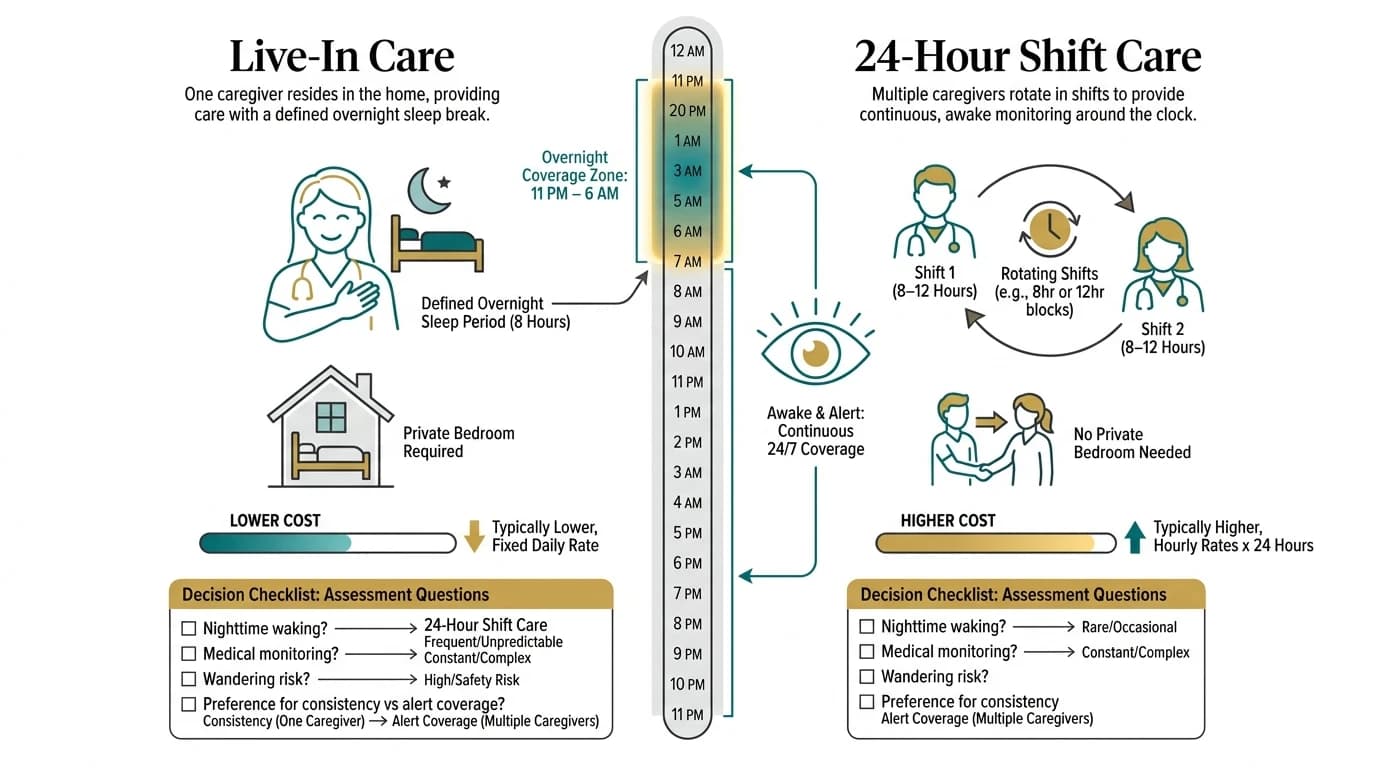
When a parent needs support around the clock, families often use "live-in care" and "24-hour care" as if they mean the same thing. They don't. Both models provide continuous coverage, but they are staffed differently, regulated differently, and priced differently. Understanding the difference before you commit to one will save you confusion later, and help you choose the arrangement that actually fits your parent's needs.
What "Live-In Care" Actually Means
In a live-in care arrangement, one caregiver resides in the home and provides care during the day, with a defined overnight sleep period built in. The caregiver isn't awake and actively working for all 24 hours: they have their own private bedroom, sleep through most of the night (unless woken for a specific need), and take breaks during the day.
This model works well for a parent who is largely independent overnight, needs help with daytime routines like bathing, meals, and mobility, and values having one consistent, familiar face in the home. In practice, families often find that live-in care suits someone in the earlier or middle stages of a condition like dementia, where nighttime waking is infrequent, rather than someone who needs hands-on repositioning or monitoring every hour.
Live-in arrangements are also shaped by labour law. If a family hires a caregiver directly (rather than through an agency), they cannot require the caregiver to live in the home; if a live-in arrangement is chosen, the employer must provide accommodation in the client's home and cannot charge the caregiver for room and board Employment and Social Development Canada. Rules about hours, wages, and rest periods for live-in caregivers vary significantly by province, so families arranging care privately should confirm the requirements with their provincial or territorial labour standards office IRCC.
What "24-Hour Shift Care" Actually Means
24-hour shift care means two or more caregivers rotate through the day in defined shifts, typically 8 or 12 hours each, so that someone is always awake and actively providing care. There is no sleep period built into the schedule: every hour is a working hour.
This model is the right choice when a parent needs frequent overnight attention: repositioning to prevent pressure sores, monitoring after a fall or hospital discharge, help with a feeding tube, or supervision for wandering related to advanced dementia. A caregiver working a shift is alert and available the entire time, not resting.
Because shift work involves fully working hours rather than a sleep period, provincial labour rules treat it differently from live-in arrangements. In Alberta, for example, caregivers working shifts of 24 hours in length are paid overtime for hours worked beyond 264 hours in a work month, while shorter shifts trigger overtime after 12 hours a day or 264 hours a month, whichever is greater Alberta.ca. Manitoba takes a different approach again: residential caregivers there are paid for 12 hours a day, split between regular wages and a different rate for the remainder, and must receive 36 consecutive hours of rest each week Manitoba Employment Standards. These examples show how much variation exists across the country, which is exactly why families benefit from working with an agency that manages scheduling, overtime, and compliance rather than trying to track it themselves.
Why the Difference Matters for Your Parent's Care
The practical difference comes down to what happens between roughly 11 p.m. and 6 a.m. If your parent sleeps through the night without needing help, live-in care is efficient and keeps continuity high: the same caregiver builds a relationship with your parent over weeks and months. If your parent needs help using the bathroom overnight, has a condition that requires monitoring, or is at high fall risk, 24-hour shift care ensures a caregiver is alert and ready to respond immediately, not woken from sleep.
A needs assessment is the best way to determine which model fits. During a Living Assistance Services in-home assessment, a care coordinator reviews your parent's mobility, cognitive status, medication schedule, and typical nighttime patterns to recommend live-in care, shift care, or a hybrid (for example, live-in care with occasional overnight shift coverage after a hospital discharge).
Cost and Staffing Considerations
Live-in care usually costs less per day than 24-hour shift care, because one caregiver's daily rate covers the full day and a sleep period rather than paying multiple caregivers for fully active shifts. Shift care costs more because every hour is a paid working hour for an alert caregiver, and because two or more people must be scheduled, trained, and coordinated.
Private-pay rates vary by region, level of care needed, and whether a nurse-supervised component like Registered Practical Nursing Care or Wound Care is involved. The most reliable way to get an accurate number for your situation is to request a written quote based on your parent's actual care plan rather than a general rate, since needs (and therefore staffing) can change month to month.
Which One Is Right for Your Family?
Start with an honest look at your parent's nights. Ask:
- Does your parent wake frequently needing physical help (toileting, repositioning, reassurance)?
- Is there a medical reason, such as a wound, feeding tube, or recent stroke, that requires overnight monitoring?
- Does your parent wander or become confused overnight due to dementia?
- Would your parent benefit more from one consistent caregiver, or from having fresh, alert coverage at all hours?
If the answer to the medical or safety questions is yes, 24-hour shift care is usually the safer and more appropriate choice, even at a higher cost. If your parent is stable overnight and values a steady relationship with one caregiver, live-in care often meets the need well.
Many families start with one model and adjust as needs change, particularly after a hospital stay, a diagnosis, or a fall. A Book a Free Assessment visit lets a Living Assistance Services care coordinator walk through your parent's routine with you and recommend the right starting point, with the flexibility to adjust the care plan as circumstances evolve.
Frequently Asked Questions
Can live-in care be upgraded to 24-hour shift care later?
Yes. Many families begin with live-in care and move to shift coverage if a parent's needs increase, for example after a fall, a hospital discharge, or a change in a dementia diagnosis. Your care coordinator can adjust the plan and staffing as those needs change.
Does a live-in caregiver work all 24 hours?
No. A live-in caregiver has a defined daily working period and an overnight sleep period, with a private bedroom in the home. They are available if woken for something urgent, but they are not actively working through the night the way a shift caregiver is.
Is 24-hour shift care always more expensive than live-in care?
Generally yes, because shift care involves multiple caregivers each paid for fully active working hours, rather than one caregiver's daily rate that includes a sleep period. Ask for a written quote based on your parent's specific care plan for an accurate comparison.
How do I know if my parent needs overnight monitoring?
Look at recent patterns: frequent nighttime waking, incontinence care needs, fall risk, wandering, or a medical condition requiring monitoring (like a wound or feeding tube) are all signs that shift care may be safer. A free in-home assessment can help clarify this, and your family doctor or care coordinator can advise on the medical factors involved.
Are live-in caregivers protected under employment standards?
Yes, but the specific protections vary by province, covering areas like hours of work, room and board, and rest periods. When care is arranged through an agency like Living Assistance Services, these employment and scheduling details are managed for you rather than falling on the family.